Baroque Pearls: Imperfection as the Highest Form of Art. Explained by a Gemologist
Good day, dear lovers of beauty!
Clients often come to me with the same question, pointing at a strikingly irregular pearl:
“Is this a defect? Or even plastic?”
Today we will talk about the object of my personal passion – baroque pearls.
Let me immediately dispel the main myth: baroque pearls are real, most often cultured pearls.
They are not artificial and certainly not “defective.”
They are a unique creation of nature – her free improvisation.
Why are they so “irregular”?
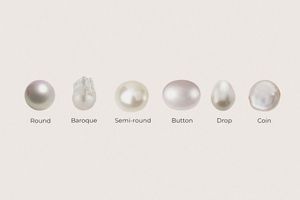
The shape of pearls is always a lottery. A perfectly round pearl is born only when the implant (nucleus) is placed in the most “ideal” part of the mollusk, and the oyster envelops it evenly throughout the months of growth.
Baroque pearls are the result of creative freedom! They form when:
· The nucleus is placed not in the gonad of the oyster, but in muscle tissue or mantle.
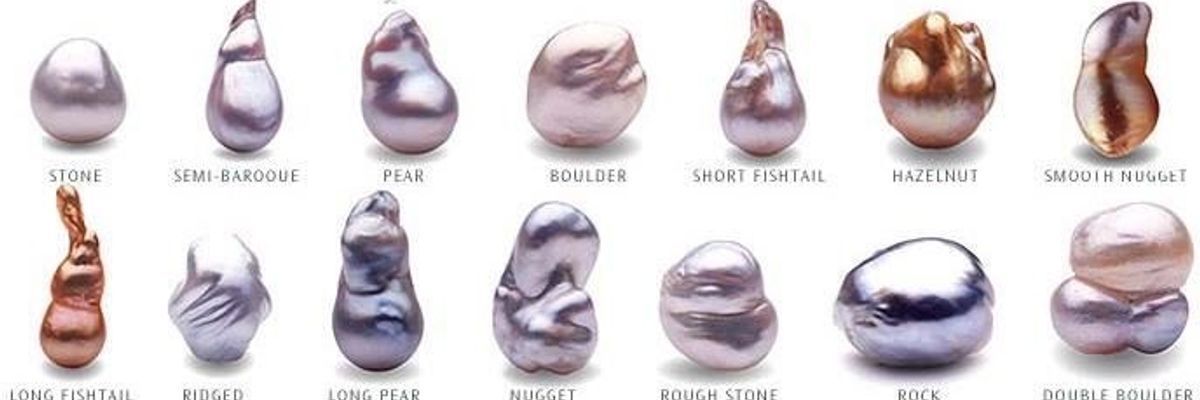
· The mollusk decides to coat the nucleus asymmetrically, however it pleases.
· Their shape is influenced by ocean currents, temperature, and the oyster’s own health.
Imagine that a perfectly round pearl is like an academic drawing, while a baroque pearl is like an abstract painting.
The value lies in the uniqueness of the brushstroke.
So why are they expensive?
Here comes the interesting part. The value of baroque pearls is not determined by their deviation from roundness.
Their worth comes from the same parameters as round pearls, but with one key addition.
- Luster:
This is the trump card! Baroque pearls, especially freshwater ones, often have a very thick nacre layer, whose structure refracts light in such a way that it creates an incredibly deep, almost liquid, iridescent glow.
Jewelers adore them for this luster. - Surface:
The quality of the surface must be high, regardless of the shape. Pearls with clean, smooth nacre without defects are valued. - Uniqueness:
This is the only type of pearl where a “defect” in shape is the main advantage.
You will never find two identical baroque pearls.
You are buying a one-of-a-kind work of art created by nature. That is their greatest value. - Size:
Baroque pearls are often very large. This is especially true of South Sea and Tahitian pearls.
Their size can reach 16–20 mm or even more.
A huge, whimsical pearl shimmering with all the colors of the rainbow is always a statement and a treasure.
Fun fact: “The Pearl of La Peregrina”
The most famous baroque pearl in history was “La Peregrina” (“The Wanderer”).
It was a huge pear-shaped pearl weighing 55.95 carats, discovered in the 16th century.
It belonged to Spanish and English monarchs, and in the 20th century was purchased by Richard Burton for Elizabeth Taylor.
Jewelers at Cartier created a luxurious pendant with diamonds and rubies to showcase it.
In 2011, it was sold at auction for a record-breaking $11.8 million.
If this isn’t proof of the immense value of baroque forms, what is?
How to wear them? An idea for a classic necklace
Here lies the magic of contrast. Baroque pearls are not for banal pieces.
They are for those who value individuality.
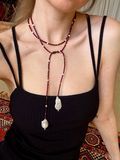
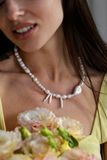
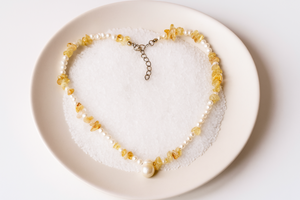
My favorite advice: create a pearl choker necklace with a central baroque element.
This is exactly the type of design we present in our store.
Imagine a classic strand of small or medium-sized Akoya pearls.
Elegant, but it may look too strict.
Now add a single large, glowing baroque pearl in the very center as a pendant.
It instantly transforms the classic jewel into a modern, artistic masterpiece.
This contrast of perfect form and free artistry creates incredible depth and character.
It says that its wearer values not only tradition but also uniqueness, and has the taste and courage to highlight her individuality.
So next time you see a whimsical pearl, don’t rush to doubt it.
Look closely at its luster, appreciate the uniqueness of its shape – before you stands not a defect, but a small miracle that will never repeat itself again.
Wear it with joy and be unique!
Your gemologist.